




Has AI already fundamentally changed the way you work? Where are you cautious?
We have now gained several years of practical experience and would like to share our current perspective as a snapshot in time. Developments are moving so quickly that some of the problems we face today may be obsolete or technically solved a year from now. Or perhaps even by the time you read this.
That is why we are particularly interested in exchanging ideas with other companies: What is working for you? Which rules have you put in place? Where are you being more cautious or bolder than we are?
We also want to use this opportunity to explain our position as a company on artificial intelligence.
Our Perspective on AI
For us, one colleague from our marketing team illustrates just how profoundly AI has changed the way we work. After just two years of parental leave, she returned to a working environment that had fundamentally changed in her absence.
Many of the tasks were still the same, but the way they were done was not. Research, translations, writing, image editing, videos, presentations and data processing could suddenly be handled using tools that previously required considerable time, external service providers or specialist knowledge.
The last time we experienced such a profound change in everyday work was probably with the rise of the internet and search engines. At some point, googling stopped being a separate tool and simply became part of the job. Something similar is happening with AI right now.
Within our company, however, there are significant differences in how AI is assessed and used depending on the area of work.
AI as a Tool
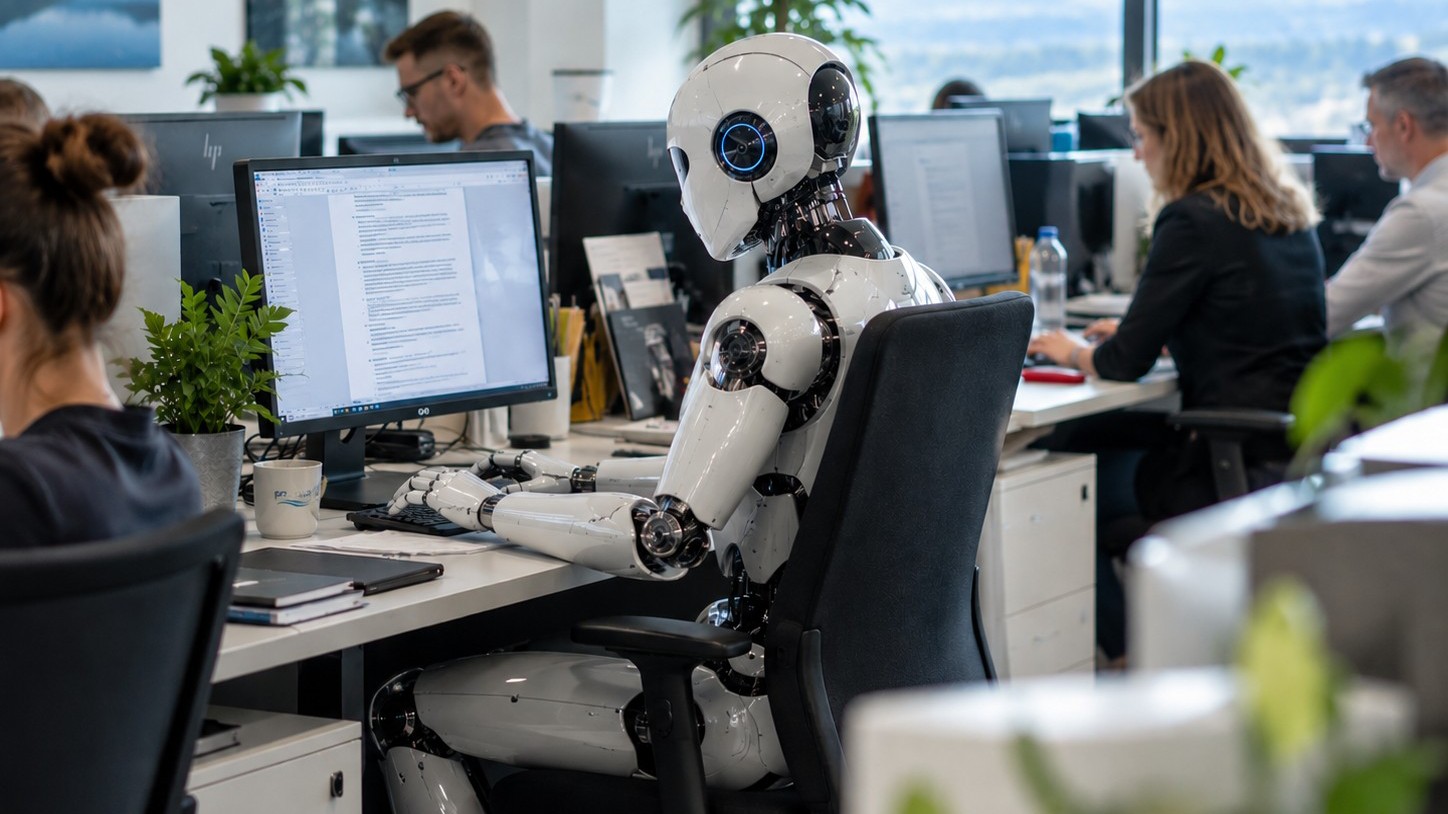
A screwdriver is good for screws and bad for nails. With a hammer, it is the other way around. A nail gun can also make a pretty effective weapon. A tool can never be assessed independently of its context and intended use.
AI as a tool is exceptionally versatile and developing very quickly. Blanket judgments are of little use. Neither unconditional enthusiasm nor outright rejection does the subject justice. What matters is which system is used, in what form, for which task, and how the relationship between effort, benefit and risk is assessed.
There are also medium- and long-term factors to consider that touch on political and social questions. In particular: How dependent do we want to become on external infrastructure over which we have no control? The same question, of course, can be asked about banks, infrastructure and transport, service providers, ISPs and many other things.
AI in Engineering and Development
pro aqua develops and manufactures technical systems for water treatment. Development, production and quality management therefore operate under demanding technical and quality requirements. Our colleagues in research, development and production are engineers through and through.
Generative AI is viewed much more critically there and used more cautiously than in marketing, sales or management. In many technical contexts, an answer that is merely likely to be correct is not good enough. An incorrect process parameter, faulty technical code, or inaccurate statement about safety, material compatibility or regulatory requirements can trigger an entire chain of problems. We therefore use AI much more defensively in these areas.
A Major Problem: Trust and Confidentiality
Alongside AI's functional weaknesses, there is a fundamental issue of trust. The major AI models could only be developed because enormous amounts of information from the internet were used for training, regardless of copyright. Authors, publishers, media companies and other rights holders are pursuing extensive legal action against major AI providers.
Development data, technical details, internal documents and customer data are at the core of our business. It would therefore be highly negligent to entrust such information to providers whose business practices we cannot fully assess.
Compliance alone is not enough for us, nor can we simply rely on promises. Most major AI providers have already experienced incidents that, given the history of the technology industry, are hardly surprising - and are highly unacceptable when security issues are involved.
Confidential development and company information is therefore just as off-limits to our AI systems as customer data and information from our quality management system. In research, development, customer-facing activities and quality management, this currently places considerable limits on the practical use of AI.

AI in Communications
In marketing, the situation is fundamentally different. A large proportion of the information we work with is intended for publication anyway or is considerably less sensitive. Errors also tend to have less critical consequences. In this sense, communications is less "sharp" than engineering. A linguistic inaccuracy will not normally trigger a cascade of technical failures.
At the same time, many of the core capabilities of generative AI overlap with central tasks in professional communications. Information has to be researched, structured, condensed, translated, visualised and prepared for a particular audience in a clear and convincing way. For our small marketing team, this represents an enormous gain in productivity and autonomy.
Work that previously required an agency can now be done in-house. Images, audio, videos, texts, translations and layouts are all produced internally. Tasks that once took several days can sometimes be completed in a single afternoon.
It is also worth noting that it is not simply the quantity of output that has increased. The quality of many results has improved because we can test more variants, make corrections faster and access specialist knowledge much more easily. This is why we adopted AI early and extensively in marketing and sales. By now, using the available tools efficiently has become a professional requirement in marketing. Anything else would be difficult to justify.
Questions of Quality and Originality
Intensive use inevitably raises many questions: Does AI change the quality of our content? How original are AI-assisted texts? How important is our personal contribution to our content? How do our target audiences perceive AI-generated material?
Part of this discussion touches directly on our understanding of what it means to be human. In his 2026 essay Die Vierte Kränkung, philosopher Rüdiger Safranski describes AI as a new challenge to humanity's self-image. After Copernicus, Darwin and Freud, another supposed human privilege is now being called into question: the idea that intellectual achievement is exclusively human.
We agree. AI unsettles us in much the same way that the first photograph is said to have unsettled Native Americans, or audiences supposedly fled a cinema screaming when they saw an early film of a steam locomotive approaching.
A 2024 study published in Scientific Reports asked participants to evaluate poems by well-known human authors and AI-generated poems. The participants were unable to identify their origin. The AI-generated poems received higher ratings across numerous quality criteria. At the same time, ratings were lower when participants believed that a poem had been generated by AI - regardless of who had actually written it. This shows how strongly AI-generated content is currently affected by bias. But we are realistic: this is most likely a temporary effect of transition and adaptation.
Magic, Deception and Fraud
In marketing, we are quite comfortable with the knowledge that almost none of the content we encounter in mass media is entirely "real". Magazine portraits are edited in Photoshop. Photos on corporate websites often come from stock libraries rather than the companies themselves. Almost every piece of music passes through numerous audio filters. And so on. Media are very often illusions. This is nothing new. The films of pioneering filmmaker Georges Méliès were rooted in stage magic and theatrical illusion.
The problem created by AI is that high-quality illusions have become so inexpensive to produce that they are no longer the privilege of agencies or professionals. These tools are now available to practically everyone, making artificial representations ubiquitous and impossible to ignore.
AI can create content that convincingly depicts something that never happened. A realistic photograph can show a fictional event. A video can attribute statements to a real person that they never made. Voices can be generated artificially and news can be automated in ways that give recipients a false impression of the actual sender. In the worst case, we may spend hours unknowingly communicating with supposed people via chat, phone or even video.
For us, these applications raise a much more important ethical question than the mere involvement of AI in a working process: the deliberate deception of people about reality.

Transparency Is the Order of the Day
The ethical difference between illusion and fraud lies in whether the audience is deceived about the reality of what is being presented. A magician does not reveal the tricks - but nobody mistakes the illusion for reality. We believe the same principle should apply to AI. That is why we consider transparency rules fundamentally sensible.
Since 2 August 2026, the transparency requirements under Article 50 of the EU AI Act have applied. There is no blanket obligation to label every piece of content in which AI has played a role. For text, for example, the regulation provides an exception where substantial human review has taken place and a person or organisation assumes editorial responsibility.
Differentiation makes sense in any case, because the boundary between human and machine assistance in everyday work is becoming increasingly blurred. Spell checking, automated translation, image editing, research tools, stock material, text suggestions and generative AI increasingly overlap.
AI Usage and Conduct Rules at pro aqua
For us, three points therefore matter above all: control of the result, responsibility for publication, and transparency wherever artificial content could be mistaken for reality.
- We do not publish any content fully automatically from an AI system.
- Content is always reviewed and edited by employees. For technical statements, the underlying sources are checked. The authors of all our content are always people.
- For images, audio and videos, we draw a clear line: if AI-generated or manipulated content could be understood as depicting a real person or a real event, its artificial origin must be identifiable.
- Several people are always involved in publications. Whether a draft was created by an employee, an intern, an AI system or an exceptionally articulate weasel, what gets published is a product of our team.
This is how we currently work with AI. It will likely continue to evolve alongside technical capabilities. We are therefore particularly interested in the experiences of other companies: Where do you draw these lines? What is already working well? Which applications have you abandoned? And which rules that seem sensible today will we probably read with a shake of the head in two years?
Sources
Safranski, R. (2026): Die Vierte Kränkung. Menschlicher Geist im Schatten der Künstlichen Intelligenz. Hanser.
Porter, B. & Machery, E. (2024): AI-generated poetry is indistinguishable from human-written poetry and is rated more favorably. Scientific Reports, 14, 26133. AI-generated poetry is indistinguishable from human-written poetry and is rated more favorably