



Every year on March 22, World Water Day draws global attention to one of the most pressing challenges of our time: worldwide water scarcity and the lack of access to clean drinking water.
While clean water is often taken for granted in industrialized nations, reports from UNICEF and other UN sources show that more than 2 billion people worldwide lack regular or secure access to safe drinking water . Depending on the definition—whether referring to basic provision or fully managed safe access—this affects approximately one in four to one in ten people globally.
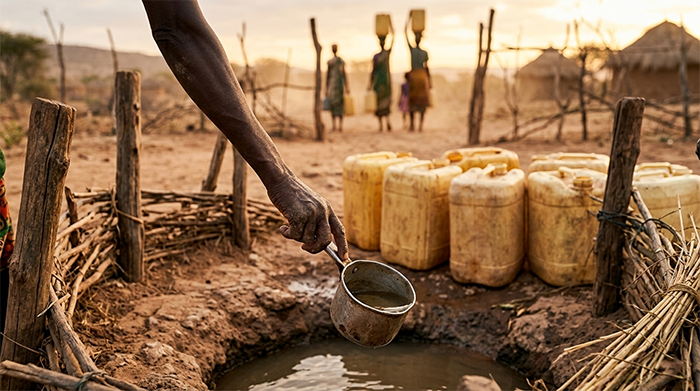
Specifically, around 2.2 billion people lack access to safe and clean water. Even more critical is the situation regarding basic supply: roughly 700 to 785 million people—approximately 10% of the world's population—do not even have minimal access to water nearby and often must walk for more than 30 minutes to collect it.
However, water scarcity is not just an environmental problem.
It is also a social and gender-specific challenge.
Water and Gender Equality – The Theme of World Water Day
Under this year’s theme, "Water and Gender" World Water Day highlights the deep connection between access to water and gender equality. In many regions, women and girls bear the primary responsibility for water collection. Consequently, they are disproportionately affected by a lack of infrastructure and, at the same time, often have significantly less influence in water policy decision-making.
Why Women Are Disproportionately Affected by the Water Crisis
The statistics reflect a clear face: that of women and girls. Globally, they are responsible for approximately 75% of water collection. Every single day, they collectively spend an incredible 200 to 250 million hours fetching water—a figure that continues to rise due to the climate crisis.
This is time lost for education, paid work, or rest. Clean water means that girls and women can use their time more meaningfully than hauling heavy canisters over miles of terrain. By improving access to water, we are investing directly in equality. Water scarcity is therefore not just an ecological or infrastructural issue—it is a massive barrier to gender equality.
Access to clean water means:
✔ Better educational opportunities for girls
✔ Economic independence for women
✔ Reduced health risks
✔ Greater stability for entire communities
✔ Increased political participation and self-determination
Water rights are women’s rights. Those who bring water to the household carry the responsibility for the health of the entire family.
Water Supply in Africa – Infrastructure and Reality
Approximately 10% of the global population lacks access to safe drinking water and is frequently forced to consume contaminated water.
In many rural regions of Africa, even basic water infrastructure is missing. People rely on unsafe sources such as open wells, rivers, or seasonal water holes.
This situation particularly endangers children, as contaminated water can transmit diseases such as diarrhea, cholera, and typhoid.
Climate Change Exacerbates Global Water Scarcity
The situation is further exacerbated by extreme weather events. Read more about this in our article: Climate Change and Water Supply: How Extreme Weather Threatens Our Most Vital Resource. Heatwaves harden soils to the point of becoming almost like concrete, after which intense monsoon rains can lead to devastating floods – as seen in Pakistan in 2022, where 33 million people were affected.
The paradox: in the midst of flooding, there is a lack of drinking water. Floods contaminate wells and pipelines with pathogens such as cholera or typhoid. This is where solutions come into play that work quickly, autonomously, and efficiently .
A problem that demands a solution – DWDU Africa makes it possible.
This is exactly where our research project begins. In 2019, on behalf of the Guerilla Foundation, pro aqua launched the project: Drinking Water Disinfection Unit – Africa" (DWDU Africa).
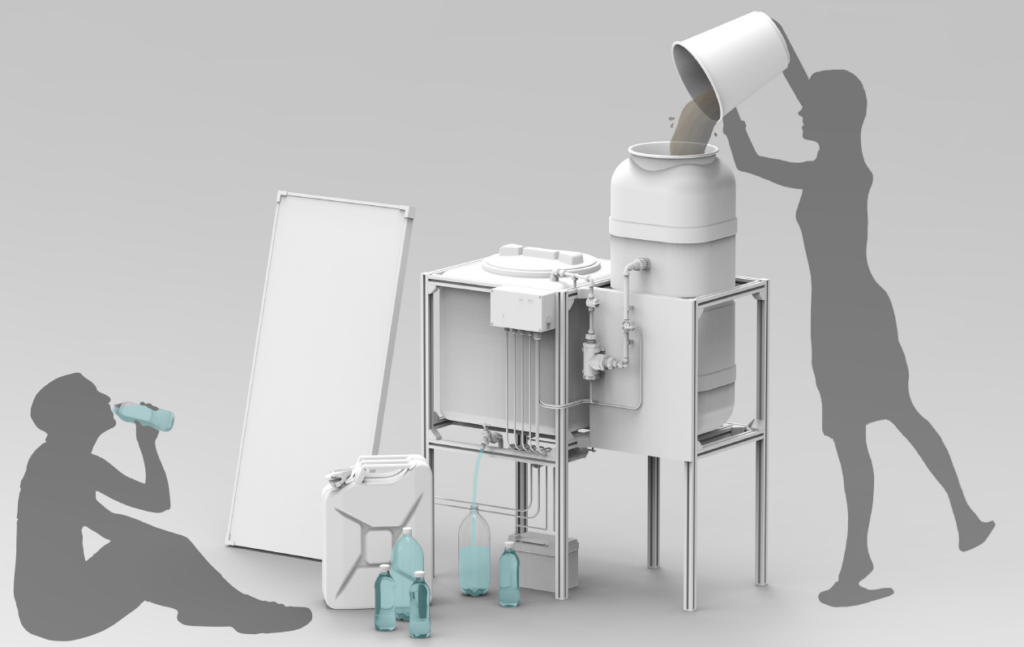
The objective was to develop a cost-effective, sustainable water treatment solution for regions with limited infrastructure. The focus was on decentralized drinking water treatment in Africa that is robust, efficient, and affordable.
Project Requirements
- Capacity: Designed to supply up to 5 households per unit
- Output: Treatment of approximately 100 liters of drinking water per day
- Target Cost: Device costs under €500
- Installation: Simple on-site assembly
- Maintenance: Straightforward and uncomplicated maintenance
- Autonomous energy supply
The Path to a Solution: Technology Meets Nature
Throughout the project, we learned that nature often provides the best answers. Our initial attempts using fine filters failed—they clogged too quickly, and the water was not filtered thoroughly enough. The solution? A classic sand filter integrated as a pre-treatment step. However, we quickly discovered that "not all sand is created equal!"
Through extensive testing, we had to determine the precise:
- Grain size distribution
- Flow rate
- Filtrationseffizienz
The concept was adapted accordingly, leading to a significantly improved system.
The Core: pro aqua Cells
Following the successful mechanical cleaning, the next step was optimal disinfection.
Two central questions were at the forefront:
- How many electrolysis cells are required?
- How must they be positioned to achieve maximum efficiency?
After an intensive testing phase, the ideal configuration was identified: pro aqua cells positioned both before and after the storage tank.
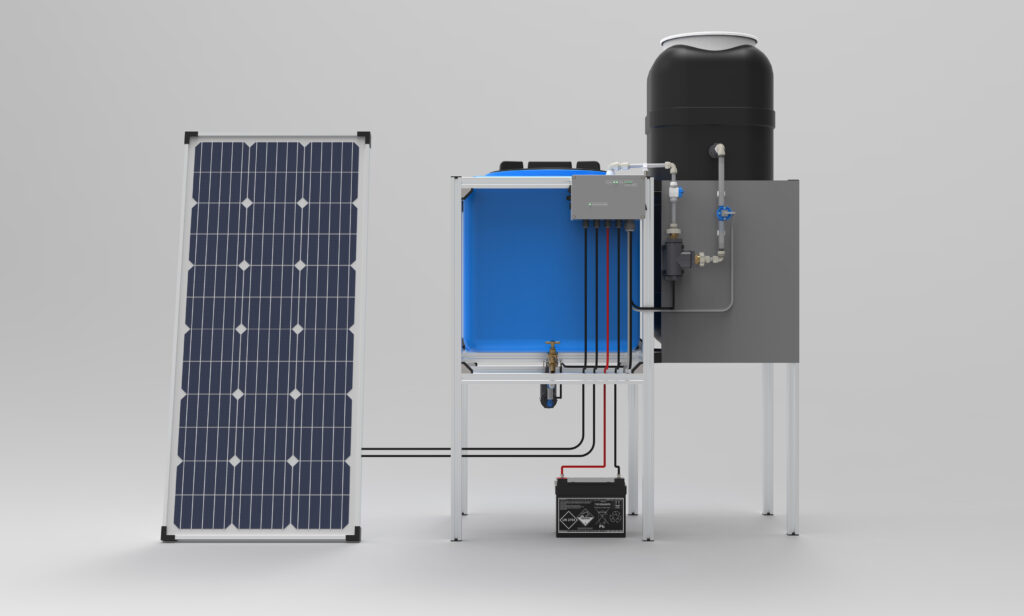
The system is powered by a small photovoltaic cell that charges a battery.
This ensures:
- Autonomous energy supply
- Operation even during poor weather conditions
- No reliance on a power grid
A robust solution for regions with unstable infrastructure.
The development of the DWDU Africa was a process full of valuable insights – from the first sketch to its deployment under real-world conditions. In our detailed article, you will find more information about DWDU Africa, the precise technical design, and comprehensive details on how this autonomous system operates.
Click here for the article: The setup of the DWDU Africa in detail
Conclusion: Diamond Moments for a Fairer World
Clean water is not a luxury; it is a human right. With projects like DWDU Africa, we demonstrate that our boron-doped diamond electrodes can make a real difference—not only in industry but also in the fight against global inequality.
When we relieve women of the burden of water collection and provide them with safe water, we transform more than just their health—we change their entire future.
Let us use this World Water Day to speak not only about water itself,
but about what clean water means for people: health, dignity, and a future.
Sources
https://www.who.int/news-room/fact-sheets/detail/drinking-water
https://www.unwater.org/water-facts/water-and-gender
https://www.unwater.org/water-facts/water-and-gender
https://www.charitywater.org/global-water-crisis
https://www.who.int/health-topics/water-sanitation-and-hygiene-wash
https://www.bmluk.gv.at/service/veranstaltungen/wasser/weltwassertag.html
https://www.unicef.org/take-action
Bilder DWDU Africa – GreenWorldTecknology, Jack Coker
Imagebilder: KI generiert