


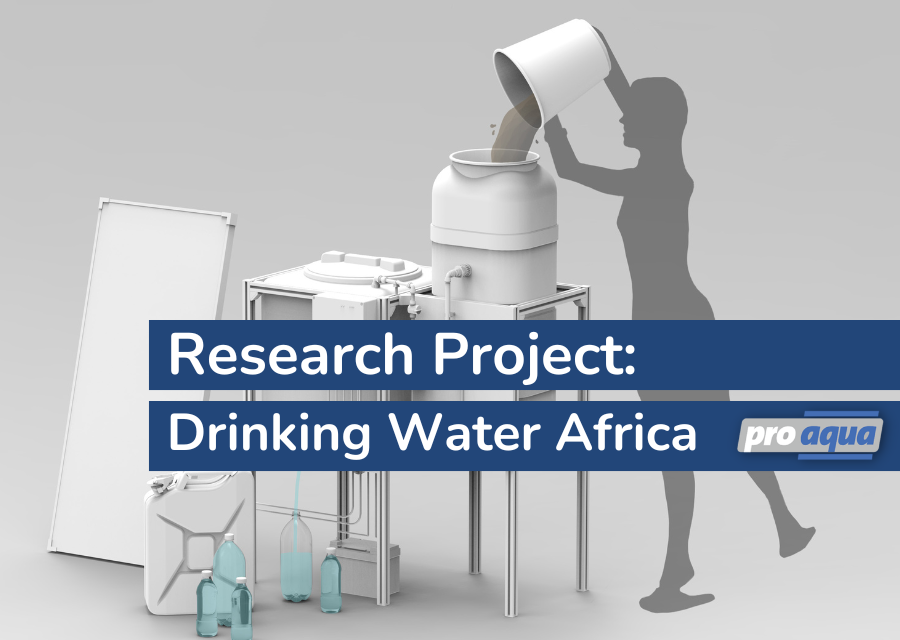

Water is the foundation for everything – health, education, and economic development. Yet, while clean drinking water is taken for granted in many parts of the world, it remains a daily struggle for survival for billions. Women and girls, in particular, bear the burden of water collection.
The figures are alarming: while 2.2 billion people lack secure access to clean water, around 700 to 785 million people even lack basic services. This affects one in ten people worldwide. The consequence is often a daily journey of over 30 minutes, which primarily women and girls must undertake just to reach water at all. Every single day, they collectively spend an incredible 200 to 250 million hours fetching water—a number that is rising even further due to the climate crisis.
This is exactly where DWDU Africa (Drinking Water Disinfection Unit) comes in. This project impressively demonstrates how pro aqua uses technology to transform social responsibility into real-world solutions.
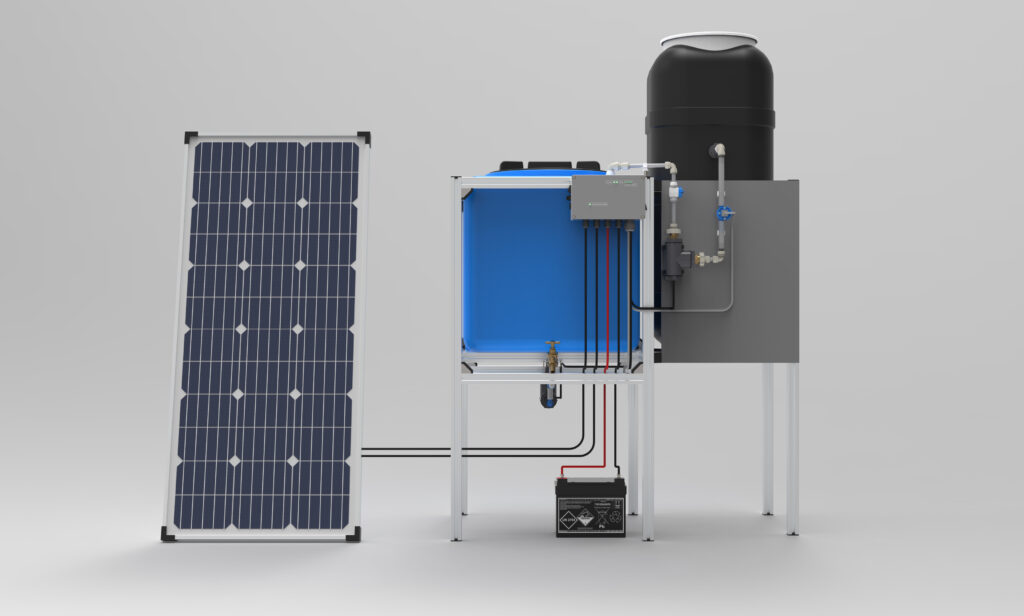
The Mission: Securing a Human Right Through Decentralization
The DWDU Africa project was launched in 2019 to tackle one of the greatest global challenges: the lack of access to safe water in remote regions. On behalf of the Guerilla Foundation, we developed a solution that had to meet clear criteria:
- Capacity: Designed to supply up to 5 households per unit
- Output: Treatment of approximately 100 liters of drinking water per day
- Target Cost: Device costs under €500
- Installation: Simple on-site assembly
- Maintenance: Straightforward and uncomplicated maintenance
- Autonomous energy supply
The main goal was a decentralized unit that can be stationed directly within communities to eliminate life-threatening contamination from bacteria and viruses.
Forward-Looking Research: The Challenges
Innovation rarely follows a straight path. During the development phase of DWDU Africa, we encountered specific challenges that required solutions beyond industrial standards.
Initial trials with ultra-fine membrane filters proved impractical, as they clogged too quickly under local conditions. The solution was a return to a proven concept combined with modern electronics: an optimized sand filter. We had to define the exact grain size and bed depth to efficiently remove turbidity without shortening maintenance intervals. Energy optimization was also crucial: How do we achieve maximum disinfection performance with minimal solar energy?
The realization that simple natural materials like sand can achieve such excellent results
Mag. Tatjana Schweiger | Project Manager DWDU Africa
has left a lasting impression on me!
High-Tech in Action: What the DWDU Africa Achieves
The heart of the system is our pro aqua cells.
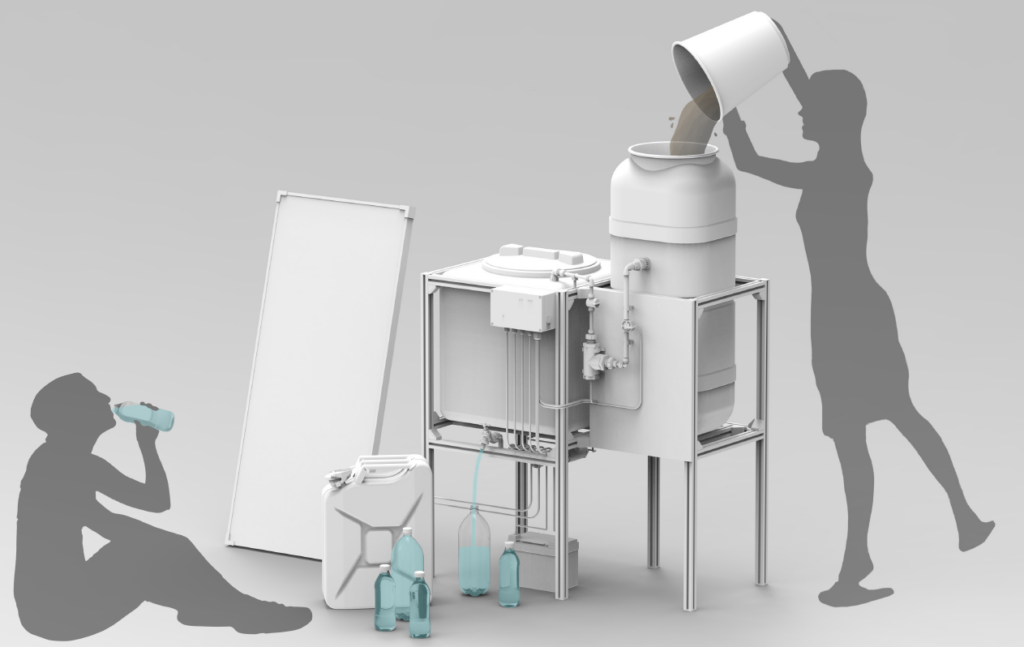
Instead of adding chlorine or other chemicals to the water, the DWDU Africa utilizes the principle of water electrolysis. The pro aqua electrodes split water molecules, generating highly active oxidizing agents directly in the water that destroy pathogens. The system delivers approximately 100 liters of pure drinking water per day—enough to reliably supply up to five households.
Technical Components in Detail
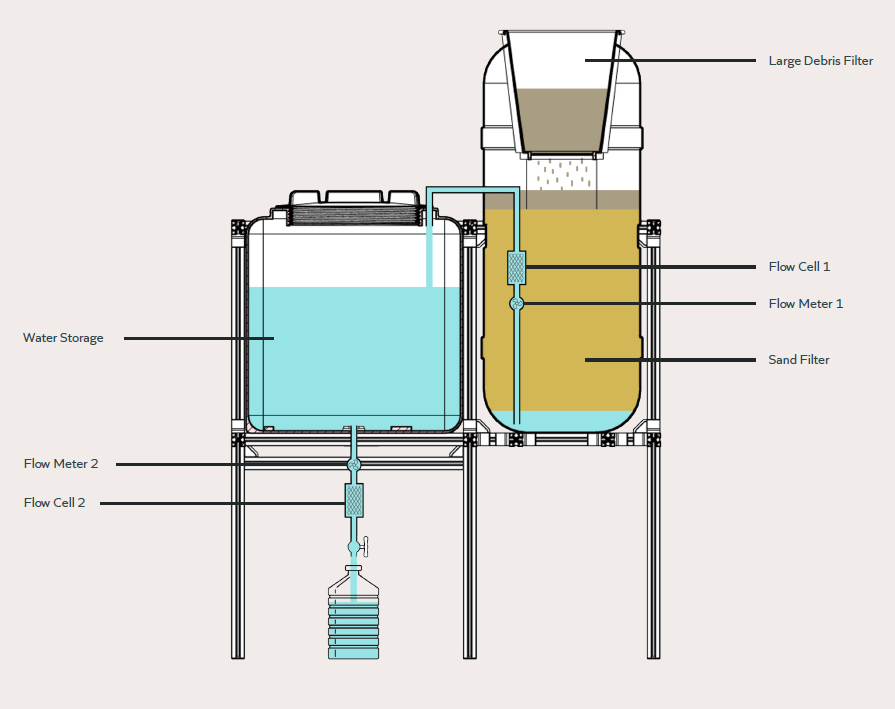
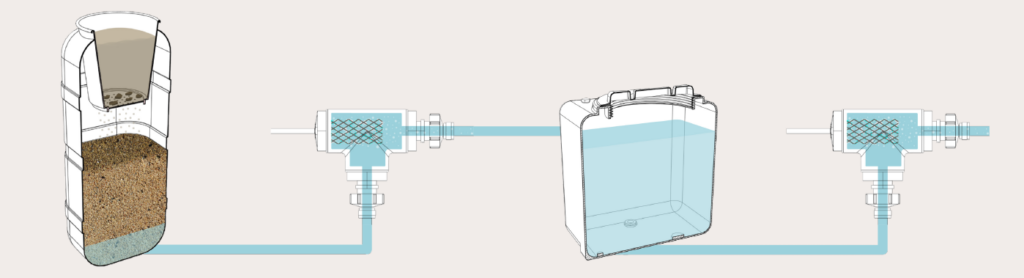
1. The Pre-filter:
Ein entnehmbarer Eimer mit spezieller Perforation dient als erste Filterstufe der DWDU. Er hält grobe Rückstände zuverlässig zurück und kann nach der Nutzung einfach entnommen und von den Nutzer:innen gereinigt werden.
2. The Sand Filter:
The sand filter clears the water of remaining suspended solids and turbidity. The system operates purely by gravity: the filtered water collects at the bottom of the tank, ready for the next step.
3. The First Sensor (Flow Meter 1):
The first flow meter registers the incoming water and sends a signal to the control panel to activate the first electrolysis cell.
4. The First Disinfection (Flow Cell 1):
In this cell, germs are neutralized directly using pro aqua electrodes, while simultaneously creating oxidizing agents that destroy remaining pathogens and viruses in the tank.
5. The Storage Tank:
The purified water is stored in a 100-liter tank, ready for immediate collection by users. Verbraucher:innen bereitsteht.
6. The Safety Sensor (Flow Meter 2):
As soon as water is drawn from the tap, the second flow meter detects the movement and activates the second electrolysis cell.
7. Final Disinfection (Flow Cell 2):
The second pro aqua cell is identical to the first and serves as an additional safety stage. This "double-layer" principle provides dual protection and eliminates any pathogens that may have entered the tank during storage.
A Modular System for Drinking Water: DWDU Africa in Action
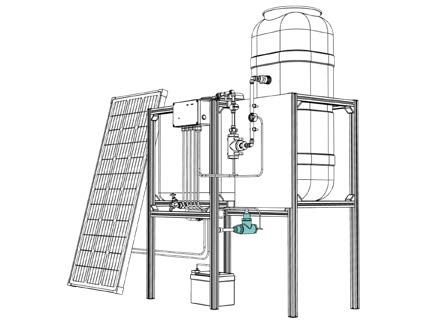
The DWDU Africa features a modular design on a sturdy aluminum frame and follows a simple yet highly effective process that puts the safety of users first.
The DWDU Africa’s 4-Step Process
To guarantee a reliable water supply in remote regions, we have created a modular process. In four clear steps, the system ensures that dangerous pathogens stand no chance, while keeping operation as intuitive as possible for local users:
1. Filtration:
A coarse pre-filter and a specialized sand filter tank for mechanical cleaning.
The process begins quite simply: Users pour the contaminated water into the pre-filter located at the top of the tank. Thanks to a special perforation in the bottom, this pre-filter acts as the first barrier, reliably retaining coarse impurities and sediment. For cleaning, it can be removed and emptied in one easy step.
The tank below forms the second mechanical filtration stage. Guided purely by natural gravity, the water seeps through a deep layer of sand that binds even the smallest suspended particles. By the time the liquid leaves this tank, it is already visually clear and ready for the subsequent disinfection via pro aqua cells.
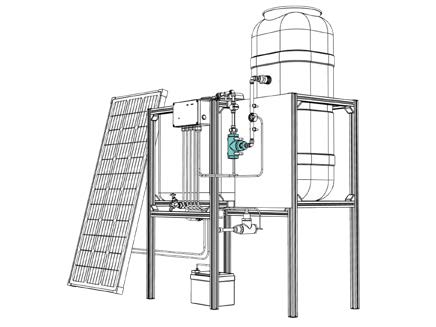
2. Disinfection:
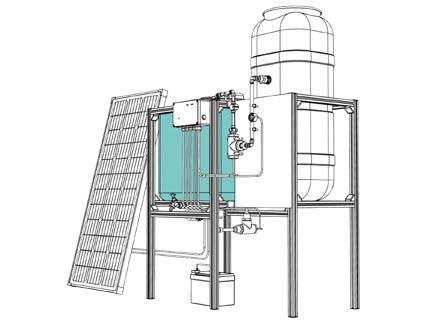
The control panel houses two flow cells (our pro aqua electrolysis cells).
After the water leaves the filtration tank, it passes through a flow meter. This sends a precise impulse to the electrolysis cell, which then activates automatically.
As the water flows through the electrolysis cell, oxidizing agents are generated directly within the water. This process is completely safe and reliably disinfects the water from pathogens. In seconds, visually clear water becomes safe drinking water—entirely without the addition of environmentally harmful or hazardous chemicals.
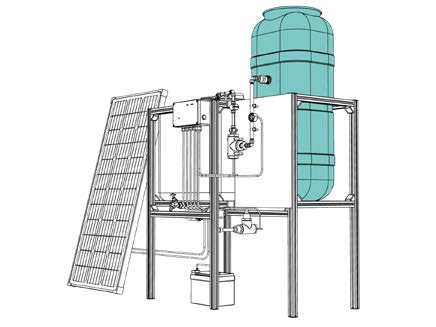
3. Storage:
A 100-liter tank provides a buffer so that water is available at all times.
The now filtered and disinfected water flows into the blue storage tank. With a capacity of up to 100 liters, it ensures that enough clean drinking water is always ready for immediate use.
Through a lid on the top of the tank, users can always keep track of the supply: it opens easily to check the current fill level and ensure the community is optimally supplied.
4. Dual Protection:
To guarantee the highest drinking water quality, a second pro aqua electrolysis cell is installed downstream from the storage tank.
As soon as users open the tap to draw water, the liquid flows through this second cell and is disinfected once more. This "dual protection" principle ensures that every drop has been disinfected, even if the water has been stored in the tank for some time. Additionally, a photovoltaic cell and a buffer battery enable completely off-grid operation.
Conclusion: Technology as a Lever for Equality
The DWDU Africa is more than just a technical device—it is a tool for social change. By enabling safe and chemical-free disinfection directly within communities, we combat the cause of many serious diseases where they originate.
The decisive factor is prevention: clean drinking water protects families from waterborne infections. Since the care of sick relatives in many cultures is performed almost exclusively by women and girls, the DWDU Africa grants them a new form of freedom. We give them back their most precious resource: time. Time for education, time for employment, and time for a self-determined life.
Can a sip of clean water change the world? Yes, especially for women and girls. Explore the deep connection between water supply, education, and equality in our blog article for World Water Day:
https://www.proaqua.at/en/wie-technologie-verantwortung-uebernimmt-die-dwdu-africa-im-fokus/
Quellen:
Graphs: Jack Coker
Cover image: AI-generated
GreenWorldTecknology
https://www.who.int/news-room/fact-sheets/detail/drinking-water
https://www.unicef.org/wash