




Today, we want to remind everyone that health risks in the fire service are more than just theoretical. Behind every statistic are real people who help others, have families, make plans for the future and rely on their health being protected as effectively as possible.
Health Protection and the Budget Question
At Oxy3, we are manufacturers in the fire service equipment market. Naturally, like everyone else in the industry, we focus heavily on economic considerations – and rightly so. Fire departments must manage their budgets responsibly, and we aim to create added value.
But there is a fundamental difference between manufacturing casual clothing and producing firefighting equipment. Our work is directly concerned with risks to people's health and lives. As our expertise grows, we become increasingly aware of the very real consequences of neglecting the issue of decontamination.

Cancer Risk in the Fire Service: Time for a Reality Check
We don't want to play on people's emotions. However, we repeatedly encounter situations where decontamination is regarded as optional, a luxury or simply unnecessary. Sometimes, there is even a complete lack of awareness of the risks involved.
We would like to contrast this with three accounts that highlight the human reality behind these issues. The stories are different, but they share one common thread: personal experience has fundamentally changed the way these individuals view health risks, prevention and protective measures.
Three People. Three Stories.
Dr. Andreas Häcker is a firefighter, internist and State Fire Service Medical Officer in Baden-Württemberg, Germany. At the age of 49, he was diagnosed with prostate cancer. It has not been established whether his illness was caused by his firefighting activities. He has been involved in the fire service since 1979 and was exposed to hazardous substances at fire scenes for decades.
In an interview, he describes how his awareness of on-scene hygiene has changed over the years. He recalls a time when on-scene hygiene played hardly any role. For Häcker, this is a reason to raise awareness about better protective measures. His clear message: education, not fearmongering. Read the full interview here.
Sid McNally, a firefighter from the United Kingdom, was diagnosed with base-of-tongue cancer in 2012. Following chemotherapy and radiotherapy, he was able to return to active duty. His colleague and friend Steve, who had been diagnosed with the same type of cancer, did not survive. McNally reports that exposure to hazardous substances was barely taken seriously for much of his career. Today, he looks critically at many past practices and is actively campaigning for better protective measures. Find out more here.
Sheryl Rodgers, a firefighter from Jacksonville, USA, was diagnosed with aggressive breast cancer in 2013 at the age of 38. Her two children were just twelve and thirteen years old at the time. She underwent intensive chemotherapy and a bilateral mastectomy. She survived the disease and has since dedicated herself to raising awareness of cancer risks in the fire service. She educates firefighters on health prevention and now supports others facing similar challenges. You can read her full story here.
When Soot Was Still a Badge of Honour
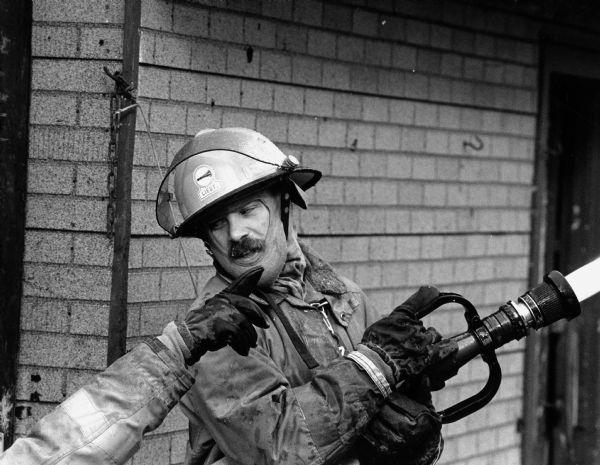
What gives us pause for thought is a recollection shared by Sid McNally. In his personal account, he describes a fire service culture in which dirty firefighting gear was worn with pride. Dirt and soot were seen as badges of honour – visible proof of the operations firefighters had carried out.
This attitude may seem strange to us today. Yet it shows just how much our understanding of safety has, fortunately, evolved. What was once accepted as an inevitable part of the job must now be approached with far greater awareness and attention.
Economic Risks vs. Biological Risks
In 2022, the International Agency for Research on Cancer (IARC), part of the World Health Organization (WHO), classified occupational exposure as a firefighter as carcinogenic to humans. There is sufficient scientific evidence of a causal link with mesothelioma and bladder cancer. However, establishing whether an individual case of cancer is attributable to occupational exposure to hazardous substances remains extremely difficult. The same applies to all three cases described above, where no definitive causal link could be established.
Without such evidence, there may appear to be no immediate legal pressure to take action. However, what matters is not whether individual cases of illness can be attributed to exposure to hazardous substances, but whether preventive protective measures have been implemented. This is both an ethical and a legal obligation, and we urge firefighters to actively demand that these measures be put in place. The statistical evidence cannot be ignored.

Responsibility Doesn't End When the Operation Is Over
We would never accept leaving a firefighter behind during an operation involving a fire. So why should we be any less committed when it comes to protecting them against contamination after the operation? Ironically, the very personal protective equipment (PPE) designed to protect firefighters can become a carrier of hazardous residues after an incident.
Cleaning is not a straightforward matter. Studies conducted by the US National Institute for Occupational Safety and Health (NIOSH) show that conventional washing methods do not remove all hazardous substances from protective clothing. A well-designed, comprehensive approach is therefore essential. This should include exposure prevention, on-scene hygiene, safe transportation, professional cleaning and additional decontamination measures, such as our Oxy3 system.
Every Life Deserves Protection
We know that firefighters are exposed to hazardous substances in the course of their work. It is therefore essential to take every reasonable and feasible measure to reduce this exposure before people fall ill and become part of the statistics.
Sources
- Feuerwehr Fachjournal: Interview mit Dr. Andreas Häcker, „Panikmache nein – Aufklären ja“ (2024)
- Fire Brigades Union: Sid McNally, „Keeping you safe from cancer-causing contaminants“ (2020)
- International Association of Fire Fighters: Sheryl Rodgers, „Cancer survivor story“ (2025)
- IARC / WHO: Occupational exposure as a firefighter, Monograph Volume 132 (2023)
- NIOSH / CDC: „Laundering Gear to Protect Firefighters“ (2026)